News
Temperature Cycling vs. Thermal Shock: What’s the Difference?
When testing the reliability of electronic components and products, temperature is one of the most important environmental stresses to consider.
- Info
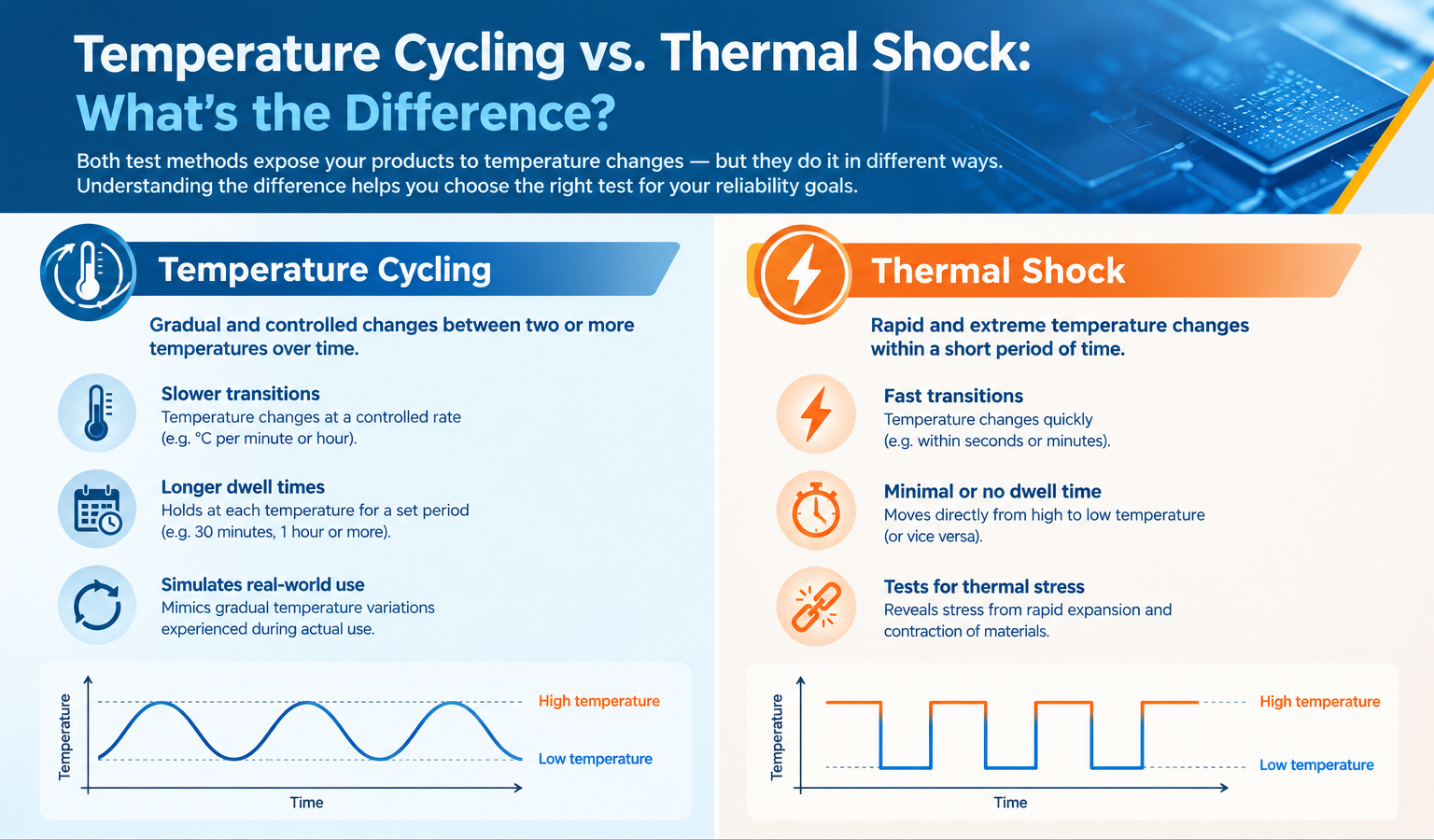
Two commonly used temperature-based reliability tests are temperature cycling and thermal shock. Although both expose products to different temperatures, the way the temperature changes—and the type of stress applied to the product—are significantly different.
Understanding the difference is important when selecting the right environmental testing equipment and test method for your application.
What Is Temperature Cycling?
Temperature cycling involves repeatedly changing a product between defined high and low temperature conditions at a controlled rate.
A typical temperature cycling profile may involve:
Low Temperature → Transition → High Temperature → Transition → Low Temperature
The cycle is then repeated for a specified number of cycles.
The temperature transition is generally controlled and relatively gradual compared with thermal shock testing.
Temperature cycling is commonly used to evaluate the effects of repeated thermal expansion and contraction on a product or component.
Over multiple cycles, differences in the thermal expansion characteristics of different materials can create mechanical stress within the product.
This can help reveal potential weaknesses such as:
- Solder joint fatigue
- Cracks in materials or components
- Connection failures
- Delamination
- Seal degradation
- Mechanical fatigue
What Is Thermal Shock?
Thermal shock testing exposes a product to a rapid change between two extreme temperature environments.
Instead of gradually changing the temperature within a single chamber, thermal shock equipment typically uses separate hot and cold zones. The test sample is rapidly transferred between these zones.
A simplified thermal shock cycle can be represented as:
Hot Zone → Rapid Transfer → Cold Zone → Rapid Transfer → Hot Zone
The rapid temperature transition creates a much more severe thermal stress on the test sample.
Thermal shock testing is commonly used when the objective is to evaluate how a product withstands sudden and significant temperature changes.
Key Difference Between Temperature Cycling and Thermal Shock
The biggest difference is the rate of temperature change and consequently the type of thermal stress experienced by the product.
| Temperature Cycling | Thermal Shock | |
| Temperature change | Controlled / gradual | Very rapid |
| Typical equipment | Environmental test chamber | Thermal shock chamber |
| Main stress | Repeated thermal expansion and contraction | Sudden thermal stress |
| Test duration | Generally longer | Generally shorter per transition |
| Application | Reliability and qualification | Severe thermal stress evaluation |
The exact temperature range, transition rate and test duration should always be determined according to the applicable test specification or customer requirement.
When Should You Use Temperature Cycling?
Temperature cycling is suitable when you want to evaluate the long-term effects of repeated temperature changes under controlled conditions.
Typical applications include:
- Semiconductor components
- Electronic assemblies
- Automotive electronics
- Connectors
- PCBs
- Sensors
- Consumer electronics
- Industrial electronic equipment
For example, an electronic component may experience significant temperature changes throughout its operating life. Repeated cycling between high and low temperatures can help engineers identify weaknesses that may not appear during a single temperature exposure.
When Should You Use Thermal Shock?
Thermal shock is more suitable when the product needs to withstand rapid and severe temperature transitions.
Typical applications include:
- Semiconductor packages
- Automotive components
- Electronic assemblies
- Aerospace components
- Materials and coatings
- Hermetic packages
- Components exposed to sudden environmental changes
The rapid transition can produce significant differences in temperature between the outer and inner portions of a test sample, creating thermal stresses that may lead to cracking, delamination or other failures.
Which Test Is More Severe?
It is tempting to say that thermal shock is simply “more severe” than temperature cycling. However, the two tests are designed to evaluate different failure mechanisms.
Thermal shock generally creates a higher rate of thermal stress because of the rapid temperature transition.
Temperature cycling, on the other hand, can subject a product to a much larger number of repeated thermal cycles over an extended test period.
Therefore, the appropriate test should be selected based on the failure mechanism you want to evaluate and the applicable test requirement, rather than simply choosing the more severe test.
Choosing the Right Testing Equipment
Selecting the correct equipment starts with understanding the required test profile.
For temperature cycling, an environmental chamber may be suitable when the required temperature transition rate can be achieved within the specified test conditions.
For rapid temperature transitions between extreme hot and cold conditions, a thermal shock chamber may be more appropriate.
When selecting equipment, engineers should consider:
- Required temperature range
- Temperature transition rate
- Number of cycles
- Test sample size and quantity
- Product heat load
- Applicable testing standards
- Required chamber volume
- Monitoring and data-logging requirements
It is also important to consider the actual test conditions rather than comparing equipment based only on its maximum and minimum temperature specifications.
The Importance of the Correct Test Profile
A well-defined test profile is essential for obtaining meaningful reliability test results.
For example, a test specification may define not only the high and low temperatures, but also the dwell time, transition time, number of cycles and measurement requirements.
The testing equipment must be capable of reproducing the required profile consistently and reliably.
This is why selecting the right equipment should involve more than simply choosing a chamber based on temperature range.
Microrel Solution – Reliability Testing Solutions
At Microrel Solution, we support customers in selecting and implementing reliability testing equipment based on their specific application and test requirements.
Our solutions include:
- Environmental test chambers
- Temperature and humidity chambers
- Thermal shock chambers
- Rapid temperature change chambers
- Ovens and burn-in systems
- Vibration testing equipment
- Reliability test and monitoring solutions
From equipment selection and technical consultation to installation and commissioning, our team works with customers to develop practical testing solutions for their reliability requirements.
Need Help Selecting the Right Test?
Temperature cycling and thermal shock serve different purposes, and selecting the appropriate method can have a significant impact on your reliability testing program.
If you are unsure which test method or equipment is suitable for your application, Microrel Solution can help you evaluate your requirements and identify the appropriate testing solution.
Contact us to discuss your reliability testing requirements.